Early investment from The RYR-1 Foundation helped build critical research tools and support an innovative strategy now being pursued as part of a renewed NIH-funded project led by Drs. Robert Dirksen and James Dowling
News Release
PITTSBURGH, PA – A research collaboration focused on developing new treatments for RYR-1-Related Diseases (RYR-1-RD) has reached an important milestone, as a previously funded National Institutes of Health (NIH) research project led by Drs. Robert Dirksen and James Dowling was recently renewed and expanded to to include the development of three new therapeutic approaches.
The renewed project, “Pathophysiology and Treatment of Recessive RYR1 Related Myopathy,” includes multiple research aims. One new aim will investigate whether an innovative gene therapy strategy can overcome one of the biggest challenges facing the development of treatments for RYR-1-RD: the RYR1 gene is too large to fit into a single gene therapy delivery vehicle.
To lead this new area of research, Drs. Dirksen and Dowling recruited Dr. Hichem Tasfaout, Assistant Professor in the Departments of Neurology and Bioengineering at the University of Washington and a faculty member of the Institute for Stem Cell and Regenerative Medicine, into the project.
Dr. Tasfaout will lead the research focused on a technique known as split intein protein trans-splicing, an innovative strategy designed to potentially deliver the very large RYR1 gene to muscle cells.
Tackling a major challenge in RYR1 gene therapy
Gene therapy works, in part, by delivering genetic instructions into cells so they can produce a needed protein. One commonly used delivery vehicle is an adeno-associated virus, or AAV.
The challenge for RYR-1-RD is that the RYR1 gene is exceptionally large, too large to fit into a single AAV vector.
Dr. Tasfaout and his collaborators are investigating whether they can work around this limitation by splitting the RYR1 gene into multiple smaller fragments. The fragmented parts would be delivered separately, and using the split-intein approach, researchers hope they can be reassembled inside muscle cells to produce fully functional ryanodine receptor (RyR1) proteins.
The research will determine whether muscle-targeted expression of normal, or “wild-type,” RyR1 using this approach can provide therapeutic benefit in mouse models of severe, recessive RYR1-Related Myopathy (RYR1-RM).
This is an early-stage research effort, and significant scientific work remains before any potential therapy could be considered for use in patients. However, the approach addresses a fundamental technical barrier to developing RYR1 gene therapy and represents an important new direction for the field.
A renewal built on years of The RYR-1 Foundation-supported research
The new work builds on research that has been underway for years.
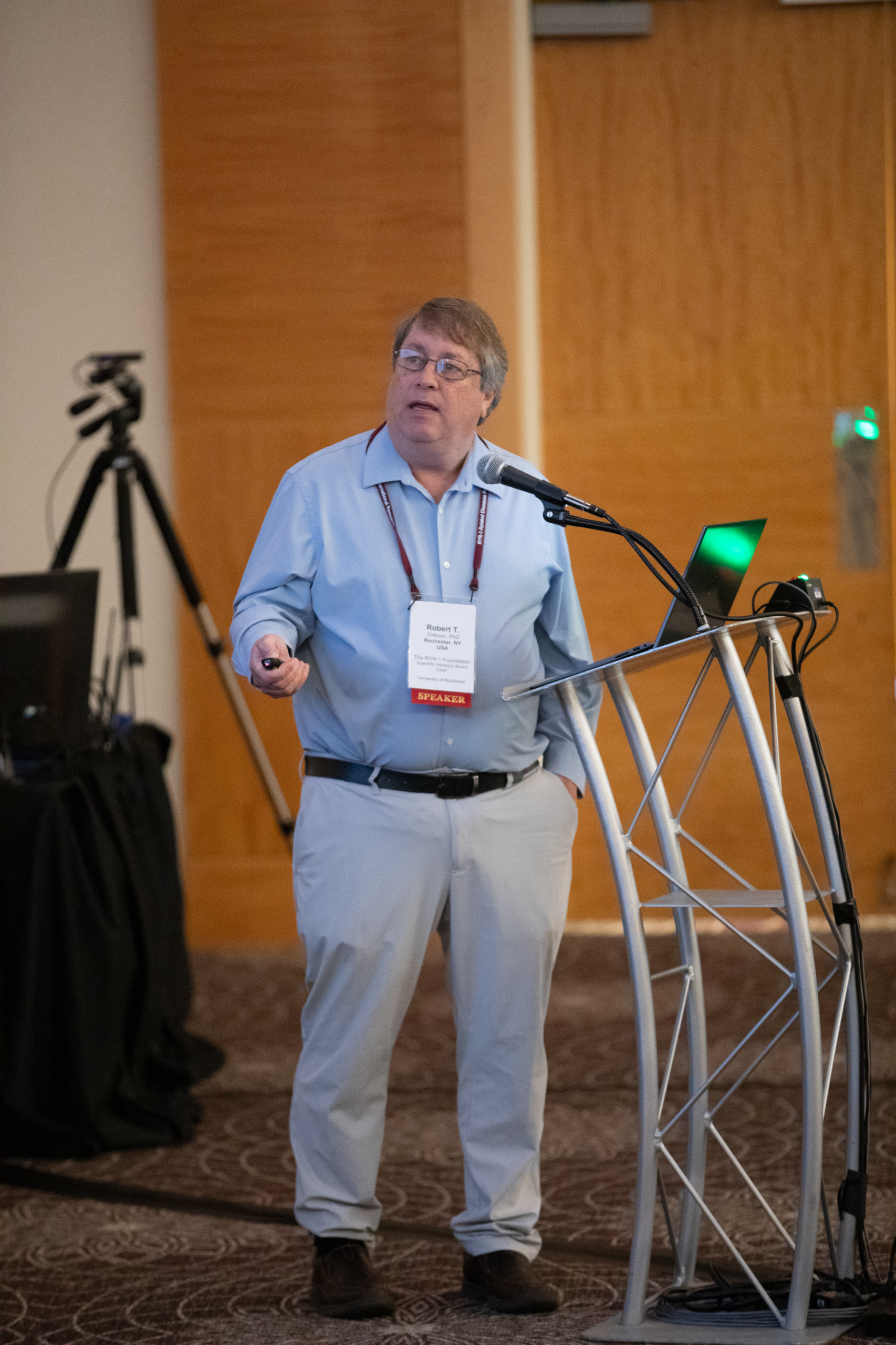
In 2020, Robert T. Dirksen, PhD, Lewis Pratt Ross Professor and Chair of the Department of Pharmacology and Physiology at the University of Rochester, and James Dowling, MD, PhD, Professor of Genetics and Neurology at the University of Pennsylvania and Director of the Penn Neurogenetics Therapy Center, were awarded an NIH R01 grant of more than $2 million for their project investigating the causes and potential treatments of recessive RYR1-RM. Both Drs. Dirksen and Dowling are members of The RYR-1 Foundation’s Scientific Advisory Board, with Dr. Dirksen serving as its Chair.
During the prior funding period, the researchers developed and characterized two new mouse models of severe, recessive RYR1-RM. These models were developed with scientific guidance from The RYR-1 Foundation’s Scientific Advisory Board and financial support from The RYR-1 Foundation.
The models are valuable tools for the RYR-1-RD research community. They allow scientists to study severe recessive RYR1-RM and test potential treatments in the laboratory before therapies can ever be considered for human studies.
“The RYR-1 Foundation’s development and sharing of these pre-clinical models of severe RYR1 myopathy open up opportunities for researchers in the field to better understand disease pathways, and importantly, to develop, optimize, and validate new therapeutic interventions. These critical pre-clinical studies are needed for future FDA approval and translation in early-stage clinical trials.” said Dr. Robert Dirksen.
With the renewal of their NIH project, Drs. Dirksen and Dowling are building on that foundation by pursuing exciting new research questions and therapeutic approaches, including the split-intein strategy being led by Dr. Tasfaout.
The power of early investment
The RYR-1 Foundation’s role in this research illustrates why early investment is so important in rare disease science.
In 2024, The RYR-1 Foundation awarded Dr. Tasfaout a $120,000 Individual Investigator Grant to support his work exploring the feasibility of applying the split-intein approach to the RYR1 gene and generating preliminary data.
That early investment helped support the development of the scientific foundation needed to pursue the strategy further. Dr. Tasfaout is now bringing that expertise into the renewed NIH project led by Drs. Dirksen and Dowling, where the approach will be investigated as one component of a broader research program.
This progression, from The RYR-1 Foundation-supported generation of new research tools and pre-clinical models, to early investigator funding, to a new collaborative research aim within a renewed NIH grant, illustrates how rare disease organizations can help create opportunities for scientific advances that may ultimately lead to new treatments.
“This is exactly why The RYR-1 Foundation exists,” said Dr. Michael Goldberg, Board President and Co-Chair of Research of The RYR-1 Foundation. “Innovative ideas often require early support before they can attract major federal funding. By investing in promising science, building research tools, and connecting experts from different fields, we are helping create the pathway toward future treatments.”
Building momentum for the future
The renewal of the Dirksen-Dowling NIH project and the addition of the split-intein research aim represent another step forward in the effort to develop treatments for RYR-1-RD.
Importantly, this milestone is not the result of a single grant or a single laboratory. It reflects the cumulative impact of building research tools, supporting promising investigators, and bringing complementary scientific expertise together.
The RYR-1 Foundation’s early support helped researchers develop critical mouse models. Its later investment supported Dr. Tasfaout’s work to generate preliminary data around a promising novel gene therapy strategy. That expertise is now being incorporated into a broader, renewed NIH-funded research program led by Drs. Dirksen and Dowling.
While substantial scientific work remains before any potential therapy or cure can reach patients, this progress demonstrates how strategic investment in rare disease research moves innovative ideas forward.
For individuals and families affected by RYR-1-RD, each step matters.
The RYR-1 Foundation remains committed to supporting bold ideas, developing essential research tools, fostering collaboration among leading scientists, and building the research community needed to turn discoveries into treatments.
This is our mission in action.
