
Dear Friends,
Happy Spring! As the days grow longer, spring reminds us that progress often starts quietly, with small signs of growth that eventually lead to meaningful change. In many ways, the spirit of renewal reflects the work of our community every day: advancing research, sharing knowledge, and supporting one another on the journey toward better treatments and, ultimately, cures for RYR-1-Related Diseases (RYR-1-RD).
As a reminder, we’re now accepting applications for The RYR-1 Foundation’s 2026 – 2028 Research Grant Cycle. Supporting innovative research is part of our mission, and these grants are designed to accelerate the development of effective therapies for RYR-1-RD. We encourage qualified researchers around the world to apply, particularly those working in our current Research Priority Areas focused on readthrough therapies for nonsense variants and variant-agnostic therapeutic strategies for dominant forms of RYR-1-related myopathy. If you know a researcher or institution doing promising work, please consider sharing this opportunity.
We are also highlighting several important resources and opportunities for our community in this issue. A new study examining congenital myopathies provides valuable insight into how frequently these conditions occur and why counting every diagnosed case matters for understanding their true impact. We’re also sharing the #RAREis Scholarship Fund from the EveryLife Foundation for Rare Diseases, which is now open and offers $5,000 awards to individuals living with rare diseases who are pursuing educational opportunities, with applications due April 28.
We’re also sharing helpful resources from the National Organization for Rare Disorders (NORD), an upcoming educational webinar on navigating Medicare enrollment, and an opportunity to contribute to critical research through the NIH Natural History Study of RYR-1-Related Disorders.
Every step forward in research, every new resource shared, and every individual who participates in a study brings us closer to better care and new treatments for the RYR-1-RD community. Thank you for being part of this mission and for the many ways you help move our work forward.
Wishing you a wonderful start to the season.
Best,
 |
| Lindsay Goldberg, BSN, RN Executive Director, Patient Liaison & Co-Founder The RYR-1 Foundation |
The RYR-1 Foundation is now accepting applications for the 2026 – 2028 Research Grant Cycle. This funding opportunity supports innovative scientific research focused on advancing treatments and cures for RYR-1-Related Diseases (RYR-1-RD).
We encourage researchers and scientists to submit proposals aligned with our current Research Priority Areas (RPAs).
Research Priority Areas
-
Readthrough Therapies for RYR-1-Related Disease Due to Nonsense Variants
-
Variant-Agnostic Therapeutic Strategies for Dominant Forms of RYR-1-Related Myopathy
Who Can Apply
Applicants must hold a Ph.D., M.D., D.V.M., D.O., or equivalent degree and have a faculty or equivalent appointment at a domestic or international nonprofit organization or at a public or private institution, such as a university, medical school, hospital, or research institute.
About the Award
The Individual Investigator Research Grant Awards are designed to support high-impact research projects with strong potential to accelerate the development of effective treatments and cures for RYR-1-RD.
Key Dates
-
Application Deadline: May 16, 2026
-
Funding Decisions Announced By: July 17, 2026
Learn More
Program Guidelines along with additional information are available on our website.
Questions?
Please contact Lena Leghart, Program Manager.

Supporting Your Future: Scholarships for Individuals
Living with Rare Diseases
The EveryLife Foundation for Rare Diseases is now accepting applications for the #RAREis Scholarship Fund, which supports adults living with rare diseases in pursuing a wide range of educational opportunities, regardless of treatment status. With generous support from Amgen, up to 58 one-time scholarships of $5,000 will be awarded for the Fall 2026 semester. The program is administered by Scholarship America, the nation’s largest designer and manager of scholarship programs.
Eligible applicants:
-
Must be a US resident who has been diagnosed by a physician with any form of rare disease (undiagnosed individuals may apply with a completed Diagnosis Verification Form),
-
Must be 17 years of age or older with no upper age limit, and
-
Must be currently enrolled or planning to enroll full- or part-time in an accredited undergraduate, graduate, or vocational/trade program for Fall 2026 (note that even one class qualifies as part-time).
Applications are open now and must be submitted by April 28, 2026, at 3:00 pm CT, with award notifications expected in June. While not all applicants will be selected, students may reapply each year they meet eligibility requirements. Applicants will be required to submit a physician-completed Diagnosis Verification Form, and all communications will be sent via email, so it is strongly recommended to use a personal email address when applying rather than a school or work account. For questions or support, applicants can contact rareis@scholarshipamerica.org or call (507) 931-0799.
A recent study, “Incidence and Prevalence of Congenital Myopathies – A Population-Based Study From Western Sweden,” published in Annals of Neurology, examined how common congenital myopathies, rare genetic conditions that affect muscle function from birth, are within the population. Researchers reviewed medical records from western Sweden between 1985 and 2022 and identified 104 individuals diagnosed with congenital myopathy during that time, including those who had passed away. By counting all diagnosed cases, not just people currently living with the condition, the researchers estimated that about 15 out of every 100,000 babies are born with a congenital myopathy, while roughly 4 out of every 100,000 people are living with the condition at any given time. The most common types of congenital myopathy identified were those with nonspecific muscle changes, followed by core myopathy and centronuclear myopathy. The study also found that changes in the genes MYH2 and RYR1 were among the most common genetic causes. Even with modern genetic testing, about one in five patients still did not have a confirmed genetic cause identified.
“This study is highly relevant to the RYR-1-Related Diseases (RYR-1-RD) community because it reinforces that RYR1 variants remain one of the most common genetic causes of congenital myopathies, while also showing that the true burden of these conditions is likely underestimated when we look only at those living with the disease,” said Michael Goldberg, Board President & Co-Chair of Research, The RYR-1 Foundation. “By incorporating both incidence and mortality, these findings provide a more accurate picture of how frequently RYR-1-RD occur, which is critical for advancing research, improving diagnosis, and ensuring appropriate resources and clinical trial readiness for our community.”
Importantly, the study highlights that counting all diagnosed cases, including those who have died, provides a more accurate understanding of how frequently these conditions occur, which can help guide healthcare planning, research efforts, and support for affected families.
| Read Full Article |

The National Organization for Rare Disorders (NORD) is an independent nonprofit supporting individuals and families affected by rare diseases. As the first and only organization serving all rare disease communities, NORD works across care, research, policy, and community to ensure patients are seen, heard, and supported. Its policies and priorities are guided by patients and families, with full independence from industry influence.
Explore their website to manage your care:
-
Find Expert Care – Locate specialists familiar with your rare disease
-
Navigate Your Disease – Disease-specific information and resources
-
Patient Assistance – Discover support programs and resources
-
Telemedicine Resources – Connect with care remotely
Visit NORD today to access these valuable tools and support your journey with RYR-1-RD.
Explore NORD

On April 22, 2026, at 1 pm ET, Triage Health will host “Medicare Made Simple: A Guide for First-Time Enrollees” presented by Triage Cancer Senior Staff Attorney Amanda Goodstadt, Esq.
This informative webinar will cover:
-
Key enrollment deadlines
-
How Medicare works with other insurance coverage
-
Tips to avoid common mistakes
By attending, you’ll be able to:
-
Identify the different parts of Medicare and understand what each covers and costs
-
Explain the Initial Enrollment Period, including important deadlines and potential consequences of delayed enrollment
-
Understand how Medicare interacts with other insurance, such as employer-sponsored plans or COBRA
Plus, all attendees will have the opportunity to ask questions live!
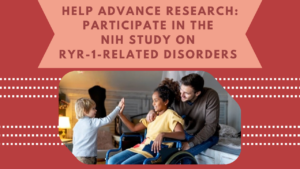
You can still take part in the Natural History Study of RYR-1-Related Disorders (RYR-1-RD), currently underway at the National Institutes of Health (NIH). This study is helping researchers understand how RYR-1-RD develops and changes over time in both children and adults—information that could shape future treatments and care.
The research is led by Tokunbor A. Lawal, PhD, FNP-BC, an independent scholar in the NIH’s Division of Intramural Research.
Who Can Join?
-
Individuals age 7 and older
-
Those with a confirmed genetic diagnosis of RYR-1-RD
-
U.S. residents
Who Cannot Participate?
-
Anyone with other neuromuscular conditions causing muscle weakness
How to Get Involved
For more information or to see if you qualify, reach out to the NIH Office of Patient Recruitment at (800) 411-1222 or ccopr@nih.gov. Be sure to reference Research Study #001737-CC.
By joining, you can help advance research, improve understanding, and support the development of future therapies for the RYR-1-RD community. Every participant makes a difference!

