
|
Dear Friends, Rare Disease Day is almost here, and as February 28 approaches, we are proud to stand alongside the global rare disease community in raising awareness for RYR-1-Related Diseases (RYR-1-RD). This month, we invite you to Show Your Stripes with us; a powerful symbol of strength, resilience, and unity. Together, we can amplify awareness of RYR-1-RD while honoring the courage and perseverance of this extraordinary community. We are also thrilled to welcome Joshua J. Todd, PhD, MBA, as the newest member of our Scientific Advisory Board (SAB). Dr. Todd brings extensive experience in clinical and translational research for rare neuromuscular diseases and has played a key role in advancing therapies for RYR1-related myopathies. His leadership and expertise will be invaluable as we continue to support research, advocacy, and patient care initiatives. In recognition of Rare Disease Day and our continued commitment to advancing science, we are also excited to announce an upcoming research grant opportunity through The RYR-1 Foundation. A new 2026 – 2028 grant cycle will open in the coming weeks! In addition, we are excited to highlight a recently published research article on Exertional Heat Stroke (EHS) and Malignant Hyperthermia (MH), which provides important insights relevant to the RYR-1-RD community and underscores the ongoing importance of research in improving diagnosis and management for patients. In this issue, you’ll find meaningful ways to get involved from Rare Disease Week on Capitol Hill and advocacy opportunities to community resources like NORD’s RareCare® Patient Assistance Programs, an educational webinar, and an ongoing research study aimed at better understanding RYR-1-RD. We’re also celebrating the Seattle Seahawks’ 2026 Super Bowl appearance. Head Coach Mike Macdonald’s continued support of our mission through My Cause My Cleats. If you’re able, we invite you to consider supporting our work through a donation in honor of Rare Disease Day. Your generosity helps strengthen the Clinical Care Guidelines, fuel critical research, and sustain programs that serve patients, families, and healthcare professionals across our community. Through awareness, advocacy, and support, we can continue moving the field forward by Strength in Numbers. Thank you for being part of this journey and for showing your stripes with pride. |
 |
| Lindsay Goldberg, BSN, RN Executive Director, Patient Liaison & Co-Founder The RYR-1 Foundation |
Rare Disease Day is almost here! On February 28, we join the global rare disease community in raising awareness for the more than 350 million people worldwide living with a rare disease.
Throughout the month, we invite you to show your stripes with us. Share your stories, tag us on social media, and help ensure your stripes are seen. Together, we can amplify awareness of RYR-1-Related Diseases (RYR-1-RD) and celebrate the resilience, strength, and perseverance of this extraordinary community.
To help celebrate Rare Disease Day, we also invite you to consider supporting our mission through a donation. Your contribution directly advances our work by helping to revise and strengthen the Clinical Care Guidelines, support critical research initiatives, and sustain our programming for patients, families, and healthcare professionals. Together, these efforts expand knowledge, improve care, and accelerate progress for the RYR-1-RD community.
Through awareness, advocacy, and support, we can continue moving the field forward.
Connect with us on social media:
Facebook: @ryr1foundation
Instagram: @theryr1foundation
LinkedIn: @the-ryr-1-foundation
X (formerly Twitter): @RYR1foundation
In addition, advocates from across the country will gather in Washington, D.C. for Rare Disease Week on Capitol Hill, taking place February 24 – 26. This annual event offers a powerful opportunity to elevate rare disease voices, engage with policymakers, and advance meaningful change on issues that matter most to our community. Join the conversation using #RareDC2026.
Key events during the week include:
-
Virtual FDA Rare Disease Day Meeting (registration available via the FDA website)
-
NIH Rare Disease Event, with both in-person and virtual attendance options (registration available via the NIH website)
If you plan to attend and would like to connect with others in the RYR-1-RD community, please contact Lena Leghart, Program Manager, to be connected.
Learn More about Rare Disease Week on Capitol Hill

Join us in congratulating the Seattle Seahawks on an outstanding achievement, winning Super Bowl 2026!
What a night for the Emerald City! The Seattle Seahawks are Super Bowl champions, and they did it with grit, heart, and that unmistakable Seattle swagger. From the first snap to the final whistle, this team showed what belief, teamwork, and relentless effort can achieve. This remarkable milestone reflects a season defined by determination, teamwork, and excellence on the field. The Seahawks’ hard work and resilience have inspired fans across the Pacific Northwest and beyond, rallying behind them as they bring in the win on football’s biggest stage.
For the second year in a row, Coach Mike Macdonald selected The RYR-1 Foundation for My Cause My Cleats to help support and raise awareness for RYR-1-Related Diseases (RYR-1-RD). The cause is deeply personal to Coach Macdonald, as his nephew, Lucas, lives with a RYR-1-RD. We are incredibly grateful for his continued support and for using his platform to shine a spotlight on The RYR-1 Foundation, the RYR-1-RD community, and RYR-1-RD.
Here’s to an unforgettable season and a victory we’ll be talking about for years! Go Hawks!
The RYR-1 Foundation is pleased to announce an upcoming 2026 – 2028 grant cycle to support innovative research advancing treatments and cures for RYR-1-Related Diseases (RYR-1-RD).
The Request for Proposals (RFP) will open in the coming weeks. Researchers and scientists are encouraged to watch for a blast email announcement when the application portal opens. If you believe you are not currently on this distribution list and would like to be included, please contact Lena Leghart, Program Manager.
Two specific Research Priority Areas (RPAs) have been identified for this grant cycle:
-
Readthrough Therapies for RYR-1-Related Disease (RYR-1-RD) Due to Nonsense Variants
-
This priority area is driven by:
-
The significant clinical severity observed in RYR-1-RD patients with nonsense variants
-
The ongoing development of a nonsense RYR-1-RD mouse model
-
Rapid advances in readthrough therapeutic strategies, including (but not limited to), small-molecule and tRNA-based approaches
-
-
-
Variant-Agnostic Therapeutic Strategies for Dominant Forms of RYR-1-Related Myopathy
-
This priority area is driven by:
-
The large number of individuals affected by dominant forms RYR-1-related myopathy
-
The potential for variant-agnostic therapies to treat broad patient population more efficiently, due to reduced technical, financial, and regulatory hurdles
-
-
Eligibility
Applicants must hold a Ph.D., M.D., D.V.M., D.O., or equivalent degree and have a faculty or equivalent position at a domestic or international nonprofit organization, or at a public or private institution (e.g., university, medical school, hospital, or research institute).
About the Award
Individual Investigator Research Grant Awards are intended to support high-impact research with strong potential to advance the development of effective treatments and cures for RYR-1-RD.
Key Dates
-
Application Deadline: May 1, 2026
-
Funding Decision Announced By: July 1, 2026
For additional questions, please contact Lena Leghart, Program Manager.
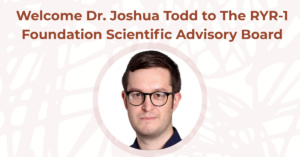
Please join us in welcoming Joshua J. Todd, PhD, MBA as our newest Scientific Advisory Board (SAB) member. Dr. Todd is a Scientific Director, Clinical Development at Neurocrine Biosciences Inc., a neuroscience-focused biopharmaceutical company based in San Diego, California. Following his doctoral training in the UK, Dr. Todd was recruited to the National Institutes of Health (NIH) Intramural Program, where he served as an investigator on the first two clinical trials for RYR1-related disorders (N-acetylcysteine and Rycals) and a prospective natural history study. As a former member of Dr. Carsten Bönnemann’s team and the Clinical Trials Unit at the NIH/NINDS, Dr. Todd also led the clinical development of gene- and transcript-directed therapies for a wide range of neurological disorders and received independent research funding from The RYR-1 Foundation and the Muscular Dystrophy Association.
Reflecting on his new role, Dr. Todd shared, “I am incredibly excited to join The RYR-1 Foundation Scientific Advisory Board and look forward to ongoing collaboration with the outstanding team of clinicians and scientists as we continue to build momentum toward a treatment for RYR1-related disorders.”
Dr. Todd brings more than a decade of leadership in clinical and translational research for rare neurological and neuromuscular diseases, with deep expertise in RYR1-related myopathies. During his tenure at the NIH, he served as a Staff Scientist and Clinical/Translational Research Lead, overseeing a broad portfolio of first-in-human through Phase II/III clinical trials, natural history studies, and nonclinical proof-of-concept programs. His work has spanned gene- and transcript-directed therapies, small molecules, antisense oligonucleotides, and innovative rare disease infrastructure.
Dr. Todd has played key roles in multiple RYR1-focused clinical programs, including leadership on the first-in-patient Phase I trial of Rycal ARM210 and Phase II trials evaluating N-acetylcysteine (NAC), as well as the development of international RYR1 patient databases and translational disease models. His contributions have been recognized with multiple honors, including NIH Bench to Bedside Awards, DDIR Innovation Awards, and The RYR-1 Foundation’s Individual Investigator Award.
Dr. Michael Goldberg, Board President and Co-Chair of Research, remarked, “Josh is a rising star in the RYR-1-RD field and has played a key role in many important basic science and clinical research projects. Over many years, I have been continually impressed by his commitment and dedication to the RYR-1-RD community. We are fortunate to have him on our Scientific Advisory Board.”
We are incredibly honored to welcome Dr. Todd to our SAB and look forward to his continued impact on advancing therapies for the RYR-1-RD community. Please join us in congratulating Dr. Todd on joining our team.
Learn More About Dr. Todd
We’re excited to share that a recently published research article, funded by The RYR-1 Foundation thanks to the generosity of several dedicated donors, has been released.
Lead author Nick Kruijt, MD, a neurologist and researcher at Radboud University Medical Centre (Radboudumc) in the Netherlands, specializes in neuromuscular disorders, including rhabdomyolysis and Exertional Heat Stroke (EHS). Commenting on the findings, Dr. Kruijt said, “We are pleased to share a recently published study in the journal Temperature on thermoregulation in individuals with a history of RYR1-related malignant hyperthermia or exertional heat stroke. The study found that thermoregulation during exercise in hot ambient conditions in these individuals showed a similar response to that of healthy individuals.”
Two members of The RYR-1 Foundation’s Scientific Advisory Board, Dr. Heinz Jungbluth and Dr. Nicol C. Voermans, also co-authored the article, titled “Thermoregulation during exercise under controlled hot ambient conditions is comparable in individuals with a history of exertional heat stroke, RYR1-related malignant hyperthermia, and healthy controls,” published in the journal Temperature. The study examined how the body regulates heat during exercise in individuals with a history of EHS, RYR1-related malignant hyperthermia (MH), and healthy controls. Participants completed a supervised cycling exercise in a warm environment while researchers closely monitored body temperature, sweating, and heat loss.
Reflecting on the study’s significance, Dr. Michael Goldberg, Board President and Co-Chair of Research, shared: “Dr. Kruijt’s paper is an important contribution to the medical literature and will help us better understand RYR-1-related malignant hyperthermia and exertional heat stroke. This project was supervised by Dr. Nicol Voermans, an internationally recognized expert in RYR-1-RD and member of The RYR-1 Foundation’s Scientific Advisory Board. The organization owes a debt of gratitude to the small group of generous benefactors whose donations made this study possible.”
The key takeaway? Under controlled conditions, individuals with MH or a history of exertional heat stroke regulated their body temperature during exercise similarly to individuals without these conditions, suggesting comparable physiological responses in monitored settings.
The researchers note that additional studies are needed to better understand why some individuals are more susceptible to EHS in real-world environments, where multiple risk factors may converge.
We are proud to support research like this that deepens understanding of RYR-1-related diseases and helps move the field forward.
NORD (National Organization for Rare Disorders) offers an invaluable resource to the rare disease community through its RareCare® Patient Assistance Programs. These programs provide critical support to individuals living with rare diseases by helping them:
-
Access necessary medications
-
Receive financial assistance with insurance premiums and co-pays
-
Obtain diagnostic testing
-
Secure travel support for clinical trials or visits with disease specialists
-
Receive caregiver respite services
-
Access support during medical or financial emergencies
-
Learn more about rare diseases
-
Connect with additional patient assistance programs
NORD’s RareCare® Patient Assistance Programs are an essential resource for the rare disease community, offering vital support to individuals and families when they need it most.

Join Triage Health on February 24 at 1 pm ET for a free webinar, Decisions About Work: Accommodations, Leave, Disability, & Retirement, designed to help individuals manage employment decisions following a medical diagnosis.
The session will address key considerations such as continuing to work during treatments, taking medical leave, replacing lost income, exploring disability and retirement options, and navigating the health insurance and financial implications associated with each decision.
By the end of the webinar, attendees will be able to:
-
Explain how the Americans with Disabilities Act (ADA) and the Family and Medical Leave Act (FMLA) can support individuals managing a medical condition
-
Describe how short- and long-term disability insurance can assist individuals who are temporarily or permanently unable to work due to a medical diagnosis
-
Compare the advantages and disadvantages of workplace accommodations, medical leave, disability benefits, and retirement options
-
Apply this knowledge to make informed decisions about managing employment and finances following a medical diagnosis
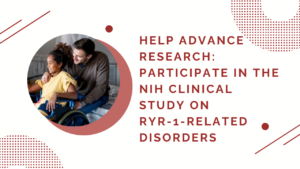
There is still an opportunity to take part in the Natural History Study on RYR-1-Related Disorders (RYR-1-RD) currently underway at the National Institutes of Health (NIH). This important research seeks to deepen understanding of how RYR-1-RD presents and progresses over time in both children and adults, helping to inform future care and treatment approaches.
The study is led by Tokunbor A. Lawal, PhD, FNP-BC, an independent research scholar in the NIH’s Division of Intramural Research.
Who Can Participate?
-
Individuals 7 years of age or older
-
Those with a confirmed genetic diagnosis of RYR-1-RD
-
U.S. residents
Who Is Not Eligible?
-
Individuals diagnosed with other neuromuscular conditions that cause muscle weakness
Interested in learning more?
To learn more or determine eligibility, please contact the NIH Office of Patient Recruitment at (800) 411-1222 or ccopr@nih.gov. When reaching out, reference Research Study #001737-CC.
Your participation can make a meaningful difference, helping advance research, improve understanding, and support the development of future treatments for the RYR-1-RD community.

