|
Dear Friends, Happy New Year! I hope your holiday season was filled with joy and that 2026 brings you and your loved ones health, happiness, and inspiration. I am deeply grateful to have each of you as part of our RYR-1-Related Diseases (RYR-1-RD) community. Thanks to your incredible generosity, our end-of-year giving campaign was a great success; we truly could not have done it without you. We are excited for all that lies ahead. We have so much to look forward to in the coming year, including a recently published article by one of our Scientific Advisory Board members, Dr. Filip Van Petegem. His research explores the effects of statins (cholesterol lowering medications) on the Ryanodine receptor 1. This work provides invaluable insight for individuals affected by RYR-1-RD, particularly regarding muscle symptoms and the potential to modify statins to help reduce these effects. We’re also looking ahead to Rare Disease Day on February 28th! Learn more below, stay connected, and keep an eye out for ways to participate and show your support. Throughout February, we hope you’ll join us in showing your stripes and sharing your stories. Rare Disease Week on Capitol Hill, taking place February 24 – 26, also offers an important opportunity to advocate for greater awareness and meaningful policy change. Triage Health is offering a free webinar with updates on key policy and legislative changes impacting the health care community in 2026. We encourage you to take advantage of this valuable resource. We are incredibly thankful to Seattle Seahawks head coach Mike Macdonald for selecting The RYR-1 Foundation for My Cause My Cleats for the second year in a row. The Fly Penguins Fly podcast episode featuring Cody Hodgson is officially live; be sure to give it a listen when you have the chance. Finally, there is still time to participate in the Natural History Study on RYR-1-Related Disorders, currently being conducted at the National Institutes of Health (NIH). This important effort helps advance understanding and future treatments. If you’re interested and meet the criteria, we encourage you to reach out to learn more. Thank you again for being part of our community and for helping make Strength In Numbers a reality. We can’t wait to see what we’ll accomplish together in 2026. Best Wishes, |
 |
| Lindsay Goldberg, BSN, RN Executive Director, Patient Liaison & Co-Founder The RYR-1 Foundation |

Starting the New Year With Gratitude
As we welcome a bright and hopeful New Year, we want to extend our heartfelt gratitude to everyone who supported us throughout this past season. Your incredible generosity, through your end-of-year gifts and the overwhelming response on GivingTuesday, has made a meaningful difference and ensures we can continue our mission with strength and purpose. Thank you for believing in our work and for standing with us.
In November 2025, Scientific Advisory Board member Dr. Filip Van Petegem published a groundbreaking article in Nature Communications titled “Cryo-electron microscopy reveals sequential binding and activation of Ryanodine Receptors by statin triplets.” His team’s research offers important new insights into why some people experience muscle-related side effects from statins, the most commonly prescribed cholesterol lowering medications.
The study used cryo-EM imaging to reveal that atorvastatin directly binds to Ryanodine Receptor 1 (RyR1) , a calcium channel in skeletal muscle—confirming it as an unintended off-target. The researchers found that three statin molecules work together to activate the channel in stages: one molecule begins to “prime” the channel, and two additional molecules ultimately push it into a fully open state. This activation may contribute to muscle symptoms experienced by some statin users, especially individuals with existing RYR1 genetic variants (mutations).
Dr. Van Petegem explains, “We were very surprised to see up to 12 atorvastatin molecules bound to a single RyR1. They bind as triplets that together force RyR1 to adopt an open conformation. The resulting calcium leak would impact muscle function and may underlie many of the reported side effects of statin use, particularly in patients with pre-existing RYR1 variants. Interestingly, there are profound differences in how atorvastatin binds RyR1 versus an enzyme involved in cholesterol synthesis. Thus, it should be possible to create atorvastatin analogs that no longer affect RyR1 while still lowering blood cholesterol levels.”
These findings not only deepen our understanding of statin intolerance but also point toward the possibility of designing modified statins that avoid interacting with RyR1, while still effectively lowering cholesterol.
Rare Disease Day is fast approaching! On February 28, we come together to raise awareness for the more than 300 million people worldwide living with a rare disease.
This February, we invite you to show your stripes with us and help amplify the voices and experiences of the RYR-1-Related Diseases (RYR-1-RD) community. Share your stories throughout the month, tag us, and let us help your stripes be seen. Together, we can shine a brighter light on RYR-1-RD and the strength of those who face these conditions every day.
Save the date! Rare Disease Week on Capitol Hill will take place February 24 – 26. This is a key opportunity for our community to come together, raise awareness, and advocate for meaningful change. Be sure to use #RareDC2026 to join the conversation. Registration opens January 7, 2026, and the agenda is already set; so mark your calendars and get ready to make an impact.
Two key highlights during the week include:
-
Virtual FDA Rare Disease Day meeting (learn more and register on the FDA webpage)
-
NIH event offering both in-person and virtual attendance (learn more and register on this website)
If you are attending and would like to connect with others in the community, please contact Lena Leghart, Program Manager, to be connected.
Learn More about Rare Disease Week on Capitol Hill
Join Triage Health for a free webinar on January 27 at 1 pm ET to learn about the latest policy and legislative updates impacting the health care community in 2026. Monica Fawzy Bryant, Esq., Triage Cancer’s Chief Mission Officer, will break down key developments from late 2025, including federal funding changes, major court cases, and newly issued health care rules and share insights on what to expect in the year ahead. Attendees will also have the opportunity to ask questions in real time through the chat box. Registration is open through the day of the webinar.
Triage Health is an educational program (a project of the nonprofit Triage Cancer) that offers free resources to help people with chronic or serious medical conditions (and their caregivers) understand the legal and practical aspects of navigating health care. These resources cover topics such as health insurance, disability benefits, employment rights, managing medical bills, estate planning, and more, with quick guides, webinars, and videos designed to break down complex information into accessible, useful content.
Register Here

We would like to express our sincere gratitude to Coach Mike Macdonald of the Seattle Seahawks for once again selecting The RYR-1 Foundation as his beneficiary for the My Cause My Cleats campaign. Through his platform, Coach Macdonald helped raise an incredible $6,675 in support of our mission. We are truly honored and grateful to have been chosen for this meaningful campaign for the second year in a row.
Thank you again to Coach Macdonald and the entire Seattle Seahawks organization for their generosity and continued support.

The special episode of the Fly Penguins Fly Podcast featuring our incredible community member, Cody Hodgson, and his journey with Malignant Hyperthermia caused by an RYR1 variant (mutation) was released in November!
This inspiring episode also features members of The RYR-1 Foundation team, including Dr. Sheila Riazi (Scientific Advisory Board Member), Dr. Michael Goldberg (Board President & Co-Chair of Research), and Lindsay Goldberg (Executive Director & Patient Liaison).
“Cody Hodgson’s journey as an NHL ice hockey player is ultimately what brought his deeper story to the attention of Fly Penguins Fly Podcast,” said Jeff Taylor, co-host of the podcast.
Recorded live at the 2025 Family Conference, Jeff sits down with Cody to discuss his remarkable hockey career, his personal experience living with RYR-1-RD, and what the future holds. Dr. Riazi, Dr. Goldberg, and Lindsay also shared important insights into RYR-1-RD research, treatment, and the growing impact of our community.
You can now listen to it on your favorite podcast platforms: Apple Podcasts, Spotify, Simplecast, Pod Paradise, Podcast Addict!
Again, a heartfelt thank you to Jeff Taylor and the entire Fly Penguins Fly team for helping amplify the voices and stories that matter most. Together, we’re spreading awareness, inspiring hope, and building a stronger community.
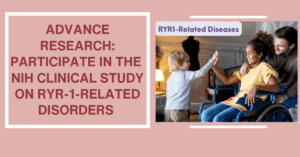
There’s still time to take part in the Natural History Study on RYR-1-Related Disorders (RYR-1-RD) currently underway at the National Institutes of Health (NIH). This important research aims to deepen our understanding of how RYR-1-RD presents and progresses in both children and adults. The study is led by Tokunbor A. Lawal, PhD, FNP-BC, an independent research scholar in the NIH’s Division of Intramural Research.
Who Can Participate?
• Individuals 7 years or older
• Those with a confirmed genetic diagnosis of RYR-1-RD
• U.S. residents
Who Is Not Eligible?
• Individuals diagnosed with other neuromuscular diseases that cause muscle weakness
Interested in Participating?
To learn more or enroll, contact the NIH Office of Patient Recruitment at (800) 411-1222 or ccopr@nih.gov. Please reference Research Study #001737-CC.
Your participation could make a meaningful difference and help advance future research and treatments for RYR-1-RD!

