
Dear Friends,
As we move through the summer months, we are excited to share several opportunities to learn, connect, and stay informed about the latest developments affecting individuals and families living with RYR-1-Related Diseases (RYR-1-RD).
This issue highlights two important educational webinars. On July 27, we will welcome experts in nutrition and neuromuscular disease to discuss how nutrition can support strength, growth, energy, and overall health. We also invite you to join us on August 17 for a special webinar featuring Dr. Sheila Riazi, who will discuss newly published recommendations for genetic testing and risk assessment in malignant hyperthermia.
We are also pleased to share news of a significant publication establishing new best-practice guidelines for genetic testing and reporting in RYR-1-RD. These recommendations represent an important step toward improving consistency, clarity, and quality in genetic diagnosis and patient care worldwide.
Research continues to advance across the RYR-1-RD landscape. In this newsletter, you’ll find information about a clinical trial currently enrolling adults with autosomal dominant RYR1-related myopathy, as well as opportunities to participate in the ongoing NIH Natural History Study. These efforts are critical to expanding our understanding of RYR-1-RD and accelerating the development of future treatments.
In addition, we encourage families to stay informed about emerging healthcare policy changes, including Medicaid work requirement proposals, and to take advantage of educational resources designed to help navigate health insurance transitions.
Thank you for being an engaged and supportive part of our community. Whether you participate in a webinar, contribute to research, advocate for access to care, or simply share information with others, your involvement helps strengthen our collective efforts to improve the lives of those affected by RYR-1-RD.
Best,
 |
| Lindsay Goldberg, BSN, RN Executive Director, Patient Liaison & Co-Founder The RYR-1 Foundation |

Join us on July 27, 2026, at 1:00 pm ET for an educational webinar exploring the vital role nutrition plays in the care and well-being of individuals living with neuromuscular diseases.
We are pleased to welcome Daniela Grote, MS from the Center for Nutritional Medicine and Prevention at Barmherzige Brüder Hospital in Munich and Jessica Nieves, MS, RD, LD, from Nationwide Children’s Hospital. Together, they will share expert insights and practical strategies to help patients, families, caregivers, and healthcare professionals better understand the connection between nutrition, strength, energy, growth, and overall health.
Whether you are newly diagnosed, caring for a loved one, or have been part of the RYR-1-RD community for years, this webinar will provide valuable information and resources to support everyday wellness and long-term health.
To help shape the discussion, attendees are encouraged to submit questions in advance through July 18, 2026. Questions from the community will help guide the conversation and ensure the topics that matter most are addressed during the webinar.
Registration is open now and will remain available until the webinar begins.
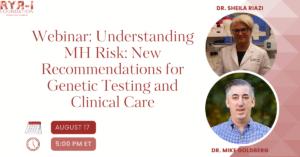
Join The RYR-1 Foundation on August 17 at 5:00 pm ET for Understanding MH Risk: New Recommendations for Genetic Testing and Clinical Care, a special webinar exploring the recently published article, A Proposed North American Approach for Genetic Testing of Individuals at Risk for Malignant Hyperthermia.
Moderated by Dr. Mike Goldberg, Board President & Co-Chair of Research of The RYR-1 Foundation, this webinar will feature Dr. Sheila Riazi, member of The RYR-1 Foundation Scientific Advisory Board and co-author of the publication. Dr. Riazi will discuss a new framework designed to help healthcare providers more effectively assess and manage Malignant Hyperthermia (MH) risk.
As genetic testing becomes more widely available, clinicians and families face important questions about interpreting results and understanding risk. This webinar will explore the role of genetic testing in MH, current limitations, and practical recommendations for improving patient care.
Developed by a multidisciplinary group of MH experts, including leaders from MHAUS and the NIH, the recommendations have been reviewed and endorsed by major anesthesia organizations across the United States and Canada.
Don’t miss this opportunity to hear directly from Dr. Riazi about the science behind these recommendations and their impact on the future of MH risk assessment and clinical care.
Register today and join us on August 17 at 5:00 pm ET.
We are excited to share that a new article “EMQN Best Practice Guidelines for Genetic Testing and Reporting in RYR1-related disorders” has been published in the European Journal of Human Genetics. We are especially proud that two members of The RYR-1 Foundation’s Scientific Advisory Board, Dr. Heinz Jungbluth and Dr. Nicol C. Voermans, served as co-authors on this important publication.
Developed by an international group of experts in anesthesia, neurology, genetics, and laboratory medicine, these guidelines are designed to help genetic testing laboratories provide clear, accurate, and consistent results for patients and families.
The RYR1 gene plays an important role in muscle function. Variants (mutations) in this gene can be linked to several conditions, including malignant hyperthermia susceptibility, RYR1-related myopathies, and exertional rhabdomyolysis. Because some RYR1 variants can be associated with more than one condition, interpreting genetic test results can be complex.
The new guidelines provide recommendations to improve how RYR1 variants are evaluated and reported, helping healthcare providers better understand a person’s potential risks and make more informed decisions about care, monitoring, and family planning. Ultimately, these recommendations aim to improve the quality and consistency of genetic testing for individuals and families affected by RYR-1-Related Diseases (RYR-1-RD).
We congratulate Dr. Jungbluth, Dr. Voermans, and their colleagues on this significant contribution to the RYR-1-RD community.
| Read Full Article |
Life changes that affect your health insurance coverage can be overwhelming, but understanding your options can help make the process easier.
Join Triage Health on July 22, 2026, at 1:00 pm ET for an informative webinar, Managing Health Insurance Transitions, presented by Laura Beilke, Esq., Staff Attorney at Triage Cancer.
This educational session will cover common health insurance transitions, including changing employer-sponsored plans, exploring options after losing employer coverage, and navigating insurance changes when relocating. The webinar will also discuss transitions between Medicaid, Medicare, and Marketplace plans, as well as important factors to consider when comparing coverage options.
Participants will learn:
-
The different health care and health insurance options available during times of transition.
-
Key factors to consider when selecting a health insurance plan.
-
Practical tips and strategies for navigating various health insurance changes with confidence.
Whether you are facing an upcoming insurance change or simply want to be prepared for the future, this webinar will provide valuable information to help you make informed decisions about your coverage.
Register Here
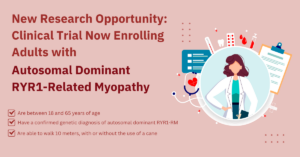
We are pleased to share that a new Phase 2 clinical trial is now enrolling adults with autosomal dominant RYR1-Related Myopathy (RYR1-RM). Sponsored by RyCarma Therapeutics, this international study will evaluate Surlorian (ARM210, S48168), an investigational therapy designed to address muscle weakness associated with RYR1-RM.
The trial will assess both the safety of the treatment and its potential to improve muscle function in adults living with the condition. Study sites are currently recruiting participants across multiple locations in Europe.
Individuals may be eligible to participate if they:
-
Are between 18 and 65 years of age
-
Have a confirmed genetic diagnosis of autosomal dominant RYR1-RM
-
Are able to walk 10 meters, with or without the use of a cane
Clinical trials play a critical role in advancing research and bringing potential new therapies closer to the RYR-1-Related Diseases (RYR-1-RD) community. We are encouraged to see continued progress in the development of treatments for individuals living with RYR-1-RD.
For more information about the study, eligibility criteria, and participating locations, visit the study listing on ClinicalTrials.gov.
The National Organization for Rare Disorders (NORD) is continuing to monitor upcoming changes to Medicaid eligibility requirements that are expected to take effect in January 2027. One of the most significant changes involves new community engagement, or work, requirements for certain Medicaid beneficiaries.
NORD is concerned about the potential impact these changes could have on individuals living with rare diseases, complex medical conditions, and the caregivers who support them. To help address these concerns, NORD recently released Access is Non-Negotiable: NORD’s Recommendations for Medicaid Work Requirement Implementation, a framework designed to help states protect patients and caregivers as they develop and implement these new policies.
The recommendations focus on important issues such as exemptions, caregiver protections, reducing administrative burdens, and ensuring patients remain engaged in the implementation process.
As discussions continue at both the federal and state levels, NORD encourages community members to stay informed and share their experiences. Personal stories help demonstrate the real-world impact these policies may have on patients, caregivers, and families.
To learn more about NORD’s recommendations and the potential changes to Medicaid coverage, visit NORD’s website. Community members who would like to share their experiences can email NORD at stories@rarediseases.org.
Review NORD’s Position and Recommendations
Enrollment remains open for the ongoing Natural History Study of RYR-1-Related Disorders (RYR-1-RD) at the National Institutes of Health. This important research effort is designed to help scientists and clinicians better understand how RYR-1-RD affects individuals over time, from childhood through adulthood.
By studying the progression of the condition, researchers hope to improve patient care, strengthen future clinical trials, and support the development of new treatment options for the RYR-1 community.
The study is led by Tokunbor A. Lawal, PhD, FNP-BC, an independent investigator within the NIH Division of Intramural Research.
Eligibility Requirements
Participants may qualify if they:
-
Are 7 years of age or older
-
Have a confirmed genetic diagnosis of RYR-1-RD
-
Reside in the United States
Individuals with other neuromuscular disorders that also cause muscle weakness are not eligible to participate.
Families and individuals interested in learning more about the study or determining eligibility are encouraged to contact the NIH Office of Patient Recruitment at (800) 411-1222 or by email at ccopr@nih.gov and reference Study #001737-CC.
Every participant contributes valuable information that helps expand scientific knowledge of RYR-1-RD and moves the field closer toward better treatments, improved care, and future breakthroughs for the entire community.