Dear Friends,
There continues to be meaningful momentum in RYR-1-Related Diseases (RYR-1-RD) research, and this month’s newsletter highlights several developments that reflect the important progress being made across our community.
From new research exploring the potential benefits of salbutamol for individuals with congenital myopathies, to a study shedding light on the everyday experiences of people living with RYR1-related malignant hyperthermia susceptibility and exertional rhabdomyolysis, researchers are continuing to deepen our understanding of RYR-1-RD and the ways they affect individuals and families.
We’re also looking ahead to an important upcoming conversation about periodic paralysis and RYR1 mutations, while sharing a recently recorded webinar on RYR1 mutations and statins. Together, these educational opportunities help connect our community with experts and provide valuable information about emerging areas of research and patient care.
Perhaps most importantly, there are growing opportunities for members of the RYR-1-RD community to take part in research. This newsletter includes information about an ongoing clinical trial evaluating an investigational treatment for RYR1-Related Myopathy, as well as an NIH Natural History Study designed to better understand RYR-1-RD over time. Participation in research can help investigators learn more about these conditions and support the development of future clinical trials and treatments.
As we look toward GivingTuesday on December 1, we’re reminded that progress is made possible not only by dedicated scientists and clinicians, but also by a community willing to come together and support the work. Together, we are Strength In Numbers. Every gift, regardless of size, helps us advance research while also providing programs, resources, advocacy, and support for individuals, families, and the broader RYR-1-RD community. We hope you’ll join us on GivingTuesday and help us build momentum toward a future with better treatments, greater understanding, and a stronger, more connected community.
As we continue to follow these developments, we remain encouraged by the dedication of researchers, clinicians, patients, and families working together to move the field forward. Thank you for being an essential part of the RYR-1-RD community and for helping advance awareness, research, and hope for the future.
Best,
 |
| Lindsay Goldberg, BSN, RN Executive Director, Patient Liaison & Co-Founder The RYR-1 Foundation |
A recent study, Effects of oral salbutamol treatment on motor function and muscle strength in congenital myopathies (COMPIS): a single-centre, randomised, open-label, blinded-endpoint, crossover trial in Sweden, published in eClinicalMedicine examined whether salbutamol, a medication commonly used for breathing conditions, could improve muscle function in children and teenagers with congenital myopathies.
The RYR-1 Foundation has been following this study closely. During the 2022 RYR-1-Related Diseases International Research Workshop: From Mechanisms to Treatments, hosted by The RYR-1 Foundation, Dr. Eva Michael, Principal Investigator of the study, presented preliminary findings from this research.
The study included 18 participants ages 6.5 – 16, including 7 with RYR-1-Related Diseases (RYR-1-RD). Researchers found that participants experienced meaningful improvements in motor function while taking salbutamol compared with usual care alone. The medication was generally well tolerated, with some participants experiencing expected side effects such as heart palpitations and tremor.
Dr. Michael Goldberg, Board President & Co-Chair of Research of The RYR-1 Foundation, shared his perspective on the impact of these findings:
“For families navigating the daily realities of congenital myopathies and RYR-1-related diseases, the lack of approved treatments has long been a profound challenge. These new findings from this trial offer a genuine spark of hope, showing that an accessible, well-known medication like salbutamol could meaningfully improve motor function and strength for affected individuals.“
While these findings are encouraging, larger studies are needed to better understand the potential benefits of salbutamol for individuals with RYR-1-RD.
A new study, Patient-reported symptoms, fatigue, functional impairment and quality of life in RYR1-related malignant hyperthermia and exertional rhabdomyolysis, published in Neuromuscular Disorders looked at how RYR1-Related Malignant Hyperthermia (MH) susceptibility and Exertional Rhabdomyolysis (ERM) can affect everyday life.
Researchers followed 50 participants and found that many reported fatigue, muscle symptoms, sleep difficulties, and challenges with daily activities and exercise. These issues were more noticeable among individuals who also experienced other muscle-related symptoms.
Importantly, the study found that anxiety and depression were not higher than in the comparison group. The findings remained consistent over the one-year study period.
Luuk van den Bersselaar, MD, noted, “This prospective clinical study presents important results about patient-reported symptoms. Study results can be used to increase awareness among healthcare professionals, improve counseling of carriers of RYR1 variants and as outcome measures for future clinical trials.”
This research provides valuable information about the day-to-day experiences of people with RYR1-Related MH and ERM and may help researchers develop meaningful ways to measure improvements in future clinical trials.
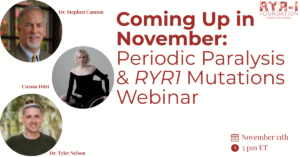
Join The RYR-1 Foundation in collaboration with the Periodic Paralysis Association on November 11 at 5:00 PM ET for an informative webinar, “Periodic Paralysis & RYR1 Mutations: Understanding the Connection”, exploring the connection between periodic paralysis and RYR1 mutations.
This webinar will feature Dr. Stephen Cannon, leading expert in periodic paralysis, and Cienna Ditri, President of the Periodic Paralysis Association. Dr. Tyler Nelson, a Board Member of the Periodic Paralysis Association, will serve as moderator. Together, they will discuss what is currently known about the relationship between periodic paralysis and RYR1 mutations, highlight ongoing research, and share important information for affected individuals, families, and healthcare providers.
Whether you or a loved one has been affected by periodic paralysis, RYR-1-Related Diseases (RYR-1-RD), or you simply want to learn more, this webinar will provide an opportunity to hear directly from experts and better understand this important area of RYR-1-RD research and patient care. We hope you will join us for this engaging discussion!
If you missed our September webinar, don’t worry, it’s now available to watch on our website!
In “RYR1 Mutations and Statins: What Clinicians and Patients Should Know,” Dr. Andrew R. Marks and Dr. Filip Van Petegem discussed the important connection between statins and RYR1 gene mutations. The speakers shared valuable insights and answered questions from members of our community, helping to provide a better understanding of this important topic.
We are incredibly grateful to Dr. Marks and Dr. Van Petegem for taking the time to participate and share their expertise with the RYR-1-related diseases community. We truly appreciate everyone’s efforts in making this informative and engaging webinar possible!
Watch The September Webinar
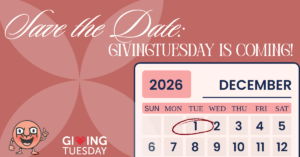
It may feel a little early to start thinking about December, but GivingTuesday 2026 is just 57 days away! Mark your calendars for Tuesday, December 1, 2026, and join The RYR-1 Foundation and our community for this special day of giving, generosity, and support. Every gift and fundraising effort helps us continue supporting research, affected individuals and family support, advocacy, and our RYR-1-related diseases community. We’ll be sharing more as GivingTuesday gets closer, so stay tuned; and save the date!
A clinical trial is bringing another potential treatment option one step closer to individuals living with RYR1-Related Myopathy (RYR1-RM).
RyCarma Therapeutics is currently conducting a Phase 2 clinical trial evaluating Surlorian (ARM210, S48168), an investigational therapy for autosomal dominant RYR1-RM.
The international study is designed to evaluate the safety and potential benefits of Surlorian, including whether the treatment may help improve muscle function and reduce muscle weakness associated with RYR1-RM. Clinical trial sites are currently enrolling participants at multiple locations across Europe.
Who May Be Eligible?
Adults may be eligible to participate if they:
- Are 18 – 65 years old
- Have a confirmed genetic diagnosis of autosomal dominant RYR1-Related Myopathy
- Can walk 10 meters, with or without a cane
Why Clinical Trials Matter
Clinical trials are an important step in the process of developing new treatments for RYR-1-Related Diseases (RYR-1-RD). Each study helps researchers learn more about potential therapies and brings us closer to finding effective treatment options for the RYR-1-RD community.
The RYR-1 Foundation is encouraged by the continued momentum in RYR-1-RD research and the growing number of efforts focused on developing potential therapies for individuals and families affected by RYR-1-RD.
To learn more about the study, eligibility requirements, and participating locations, visit the study listing on ClinicalTrials.gov.
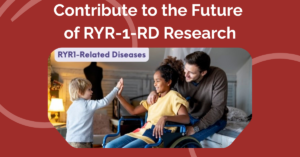
The National Institutes of Health (NIH) is actively enrolling participants in a Natural History Study of RYR-1-Related Disorders (RYR-1-RD) to better understand how these conditions affect individuals throughout their lives.
By collecting information from people living with RYR-1-RD over time, researchers hope to learn more about the experiences, challenges, and progression of these disorders. The information gathered may help improve clinical care, inform the design of future clinical trials, and support the development of potential treatments.
The study is led by Tokunbor A. Lawal, PhD, FNP-BC, an independent investigator within the NIH Division of Intramural Research.
Who Can Participate?
Individuals may be eligible if they:
- Are 7 years of age or older
- Have a confirmed genetic diagnosis of RYR-1-RD
- Live in the United States
Individuals with other neuromuscular conditions that also cause muscle weakness are not eligible to participate.
WHY PARTICIPATION MATTERS
Every participant can make a difference. By taking part in this study, individuals and families can help researchers build a better understanding of RYR-1-RD and how these conditions change over time.
The knowledge gained through natural history research can provide an important foundation for improving patient care, advancing scientific discovery, and supporting future clinical trials and treatment development.
INTERESTED IN PARTICIPATING?
Contact the NIH Office of Patient Recruitment:
📞 (800) 411-1222
📧 ccopr@nih.gov
🔎 Reference Study #001737-CC
You can also learn more about the study through ClinicalTrials.gov.
Together, researchers, patients, and families can help build a stronger future for RYR-1-RD research.