
Dear Friends,
As we welcome the fall, we are excited to share the latest news, research developments, and educational opportunities from The RYR-1 Foundation. This issue highlights the continued momentum within the RYR-1-Related Diseases (RYR-1-RD) community, from supporting innovative research to providing opportunities for individuals and families to learn from leading experts and participate in research that may help shape the future of RYR-1-RD.
We are proud to announce our 2026 – 2028 Research Grant recipients, Dr. John Lueck and Dr. Isabelle Marty, whose innovative projects are exploring promising new therapeutic approaches for RYR-1-RD. We are grateful to our community of donors and supporters whose generosity makes this research funding possible.
We are also excited to share an important example of how early investment in research can help build momentum toward future treatments or a cure. A renewed NIH-funded research project led by The RYR-1 Foundation’s Scientific Advisory Board members Dr. Robert Dirksen and Dr. James Dowling includes a new research aim led by Dr. Hichem Tasfaout.
We also have several opportunities to learn and stay connected. Join us on September 15 for our upcoming webinar, RYR1 Mutations and Statins: What Clinicians and Patients Should Know, featuring experts Dr. Andrew R. Marks and Dr. Filip Van Petegem. If you missed our recent webinars on nutrition in neuromuscular disease and malignant hyperthermia risk, recordings are now available to watch at your convenience.
And we want to hear from you! We are inviting members of the RYR-1-RD community to suggest topics, speakers, and questions for future webinars. Your feedback helps us develop educational programs that address the issues and questions that matter most to individuals and families affected by RYR-1-RD.
Finally, this issue includes information about a new clinical trial opportunity for adults with RYR1-related myopathy, as well as the ongoing NIH Natural History Study. These research opportunities are important ways for members of our community to contribute to a growing understanding of RYR-1-RD and help advance future treatments and care.
Thank you for continuing to learn, participate, share, and support The RYR-1 Foundation. Together, through research, education, and community engagement, we are moving closer to better treatments and, ultimately, a cure for RYR-1-RD.
Best,
 |
| Lindsay Goldberg, BSN, RN Executive Director, Patient Liaison & Co-Founder The RYR-1 Foundation |
We are proud to announce the recipients of The RYR-1 Foundation’s 2026 – 2028 Research Grant Awards!
Congratulations to Dr. John Lueck and Dr. Isabelle Marty on receiving funding for their innovative research projects.
Dr. John Lueck will lead the project, “ACE-tRNA Correction of Nonsense-Associated RYR1 Myopathies,” which focuses on developing readthrough therapies for RYR-1-Related Disease (RYR-1-RD) caused by nonsense mutations.
Dr. Isabelle Marty will lead the project, “Mutation-Independent Gene Therapy for Dominant RYR1 Mutations,” which focuses on variant-agnostic therapeutic strategies for dominant forms of RYR1-Related Myopathy.
These projects represent an important step toward advancing treatments for individuals and families affected by RYR-1-RD. We are excited to support this research and look forward to following its progress and the impact it will have on our community.
Dr. Michael Goldberg, President of the Board & Co-Chair of Research, shared:
“We are incredibly proud to support Dr. Lueck and Dr. Marty as they pursue innovative approaches to treating RYR-1-related diseases. Their work brings hope and moves us one step closer to a potential cure for our community. We are grateful to our donors and supporters who make this research possible.”
Please join us in congratulating Dr. Lueck and Dr. Marty!
Learn More About Currently and Prior Funded Research
A potential new research direction is advancing through a renewed NIH grant led by The RYR-1 Foundation Scientific Advisory Board members Dr. Robert Dirksen and Dr. James Dowling.
The renewed project includes three new therapeutic approaches which one new aim is led by Dr. Hichem Tasfaout to explore an innovative “split-intein” approach designed to overcome one of the biggest challenges in developing RYR1 gene therapy: the RYR1 gene is too large to fit into a single AAV delivery vector.
This work builds on years of research supported by The RYR-1 Foundation, including the development of critical mouse models and a $120,000 Individual Investigator Research Grant to Dr. Tasfaout in 2024 that supported preliminary work on this potential strategy.
While significant research remains, this milestone demonstrates how the early investment from The RYR-1 Foundation can help build the tools, generate the data, and foster the collaborations needed to advance innovative treatments for RYR-1-related diseases.
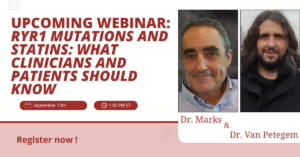
Our 2026 webinar series continues on September 15 at 1:00 pm ET with RYR1 Mutations and Statins: What Clinicians and Patients Should Know.
Join us for an informative discussion featuring The RYR-1 Foundation’s Scientific Advisory Board members Andrew R. Marks, MD and Filip Van Petegem, PhD, moderated by Dr. Michael Goldberg, President of the Board of Directors and Co-Chair of Research.
This webinar will explore the interaction between statins and the ryanodine receptor (the protein that is affected by RYR1 mutations), highlighting the latest research and what clinicians, patients, and families should know about the potential implications for individuals with RYR1 mutations.
We hope you’ll join us for this important discussion.
Exciting news! If you were unable to join us for our July and August webinars, Nutrition in Neuromuscular Disease and A New Framework for Assessing and Managing Malignant Hyperthermia Risk, both recordings are now available on our website to watch at your convenience.
Learn how nutrition can positively influence the health and well-being of individuals living with RYR-1-Related Diseases (RYR-1-RD), and discover the latest recommendations for assessing and managing Malignant Hyperthermia (MH) risk through an evolving clinical framework.
Whether you missed the live sessions or would like to revisit the presentations, we invite you to watch these informative webinars and stay up to date on the latest developments in RYR-1-RD research and clinical care.
Watch Here
Have a topic you would like to see covered in a future webinar? We invite you to share your ideas through our new form, “Suggest a Future Webinar Topic.”
Your input helps us plan meaningful educational programs that address the questions, concerns, and interests most important to the RYR-1-Related Diseases (RYR-1-RD) community. If there is a specific topic, speaker, question, or area of interest you would like us to consider, please include those details in your submission.
We carefully review all suggestions and use community feedback to help guide our future webinar programming. While we will do our best to offer webinars on the topics you suggest, we cannot guarantee that every submission will become a featured webinar.
Thank you for helping us create educational resources that best support individuals and families affected by RYR-1-RD.
Suggest a Future Webinar Topic
A new opportunity for advancing RYR-1-Related Diseases (RYR-1-RD) research is underway! RyCarma Therapeutics has launched a Phase 2 clinical trial evaluating Surlorian (ARM210, S48168), an investigational therapy being studied for adults living with autosomal dominant RYR1-Related Myopathy (RYR1-RM).
This international study aims to better understand whether Surlorian can safely improve muscle function and address muscle weakness associated with RYR1-RM. Clinical trial sites are currently enrolling participants across multiple locations in Europe.
Adults may be eligible to participate if they meet the following criteria:
- Are between 18 and 65 years of age
- Have a confirmed genetic diagnosis of autosomal dominant RYR1-RM
- Are able to walk 10 meters, with or without the use of a cane
Clinical trials are an essential part of the journey toward developing new treatment options for individuals living with RYR-1-RD. We are excited to see continued momentum in RYR-1-RD research and the advancement of potential therapies that may one day improve the lives of those affected by these conditions.
To learn more about the study, eligibility requirements, and participating locations, please visit the study listing on ClinicalTrials.gov.
Understanding how RYR-1-Related Diseases (RYR-1-RD) change over time is essential to improving care and developing future treatments. National Institutes of Health is still enrolling for the Natural History Study of RYR1-Related Disorders is actively enrolling participants to help researchers better understand the experiences, challenges, and progression of RYR-1-RD across a person’s lifetime.
By following individuals with RYR-1-RD over time, this study aims to provide valuable insights that can help improve clinical care, support the design of future clinical trials, and accelerate the development of potential therapies for the RYR-1-RD community.
The study is led by Tokunbor A. Lawal, PhD, FNP-BC, an independent investigator within the NIH Division of Intramural Research.
Who Can Participate?
Individuals may be eligible if they:
-
Are 7 years of age or older
-
Have a confirmed genetic diagnosis of RYR-1-RD
-
Live in the United States
Individuals with other neuromuscular conditions that also cause muscle weakness are not eligible to participate.
Why Participation Matters
Every person who joins this study helps build a stronger understanding of RYR-1-RD. The information collected through this research provides a critical foundation for advancing scientific discovery, improving patient care, and bringing the RYR-1-RD community closer to future treatment options.
To learn more about the study or find out if you may be eligible, please contact the NIH Office of Patient Recruitment:
📞 Phone: (800) 411-1222
📧 Email: ccopr@nih.gov
Reference Study #001737-CC
Together, participants and researchers are helping shape the future of RYR-1-RD research.