
Dear Friends,
As we approach the upcoming holiday season, we have so much to be thankful for and many exciting developments to share with the RYR-1-Related Diseases (RYR-1-RD) community. We are encouraged by the progress being made in research, our growing collaborations, and the continued dedication of everyone who supports affected individuals and their families.
In collaboration with the Periodic Paralysis Association, we are honored to host a webinar exploring the connection between RYR1 mutations and periodic paralysis, an emerging area of interest being explored by Dr. Emma Matthews and Dr. Stephen Cannon. We hope you will join us to learn more about this connection.
We’re also pleased to share that the manuscript from our 2025 RYR-1-RD Patient-Led International Research Workshop has been published! The workshop brought together affected individuals, healthcare professionals, and researchers to identify priorities for advancing research, improving diagnosis, and developing new treatments.
GivingTuesday is Tuesday, December 1! The RYR-1 Foundation’s Board of Directors will match donations dollar for dollar, up to $45,000, as part of our GivingTuesday and year-end fundraising campaigns. Your support helps advance research, education, advocacy, and community support.
We’re also highlighting new research initiatives, including a study investigating variants of uncertain significance (VUS) in RYR-1-RD, which begins by evaluating known pathogenic (disease causing) variants (mutations) which is an important first step in advancing our understanding. In addition, findings from an international patient survey exploring what affected individuals and families want and expect from future clinical trials were recently published in the Journal of Neuromuscular Diseases. The RYR-1 Foundation helped disseminate the survey, bringing together input from our Board of Directors, Scientific Advisory Board, and Board of Advisors to help ensure the community’s perspectives inform future trial development.
We’re pleased to share an opportunity for our community to help inform research into at-home muscle monitoring! We’re sharing a survey from an Oklahoma State University research team to better understand the needs of individuals at risk for rhabdomyolysis (muscle breakdown). Individuals with RYR-1-RD and other relevant conditions, and their caregivers are encouraged to participate.
We’re highlighting a valuable resource for families who need to travel to access specialized medical care. Southwest Airlines Medical Flight Network offers donated flights through nonprofit hospitals and medical transportation organizations, helping ease the burden of travel.
RyCarma Therapeutics has announced that the first patient has been dosed in its Phase 2 clinical trial of surlorian (ARM210), an investigational treatment for RYR1-related myopathy. The RYR-1 Foundation has helped raise awareness of the trial by sharing information with our community.
Finally, two important research opportunities remain open to eligible participants: the surlorian clinical trial in Europe and the Natural History Study at the National Institutes of Health in Bethesda, Maryland. We encourage interested individuals and families to learn more about these opportunities to help advance research and bring us closer to better treatments.
Thank you for your continued generosity, support, and commitment to The RYR-1 Foundation. Together, we are advancing research, strengthening our community, and building hope for everyone affected by RYR-1-RD.
Best,
 |
| Lindsay Goldberg, BSN, RN Executive Director, Patient Liaison & Co-Founder The RYR-1 Foundation |
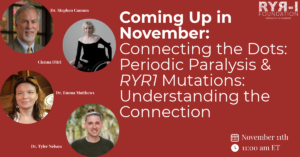
What do periodic paralysis and RYR1 mutations have in common? This emerging area of interest raises important questions for the RYR-1-Related Diseases (RYR-1-RD) community, and there is still much to learn. On November 11 at 11:00 AM ET, The RYR-1 Foundation, in collaboration with the Periodic Paralysis Association, will host an informative webinar, “Periodic Paralysis & RYR1 Mutations: Understanding the Connection.”
The discussion will bring together leading experts in periodic paralysis, including Dr. Stephen Cannon and Dr. Emma Matthews; Cienna Ditri, President of the Periodic Paralysis Association; and Dr. Tyler Nelson, a Board Member of the Periodic Paralysis Association, who will moderate the discussion.Together, they will explore what is currently known about the relationship between periodic paralysis and RYR1 mutations, discuss emerging research, and address important questions surrounding this area of RYR-1-RD.
For individuals and families affected by periodic paralysis or RYR-1-RD, this webinar offers an opportunity to hear directly from experts and gain a better understanding of this developing area of research and patient care. Whether you are personally affected, supporting a loved one, or simply interested in learning more, we invite you to join us on November 11 at 11:00 AM ET for this important conversation.
The RYR-1 Foundation is proud to announce that the manuscript from its 2025 RYR-1-Related Diseases Patient-Led International Research Workshop: Novel Perspectives, Treatments & Interventions has officially been published in the Journal of Neuromuscular Diseases. The article, “RYR1-Related Diseases Patient-Led International Research Workshop: Novel Perspectives, Treatments and Interventions,” highlights key priorities for advancing research and developing new treatments.
Currently, there are few treatments that address the underlying causes of RYR-1-Related Diseases (RYR-1-RD).
In July 2025, The RYR-1 Foundation hosted its second International Patient-Led Research Workshop in Pittsburgh, bringing together affected individuals, healthcare professionals, and researchers to identify priorities for future research.
Discussions focused on improving diagnosis, preparing for clinical trials, understanding how RYR1 gene changes affect muscles, developing research models, exploring new therapies, and examining the role of exercise and physical therapy. Participants also emphasized the importance of understanding how these diseases progress over time to help evaluate future treatments.
The RYR-1 Foundation extends its sincere thanks to everyone who participated in the Research Workshop and contributed their time, knowledge, and experiences. We are also grateful to the individuals who helped write the manuscript: Pomi Yun, Lourdes Figueroa, Chang Seok Lee, Filip Van Petegem, Nicol C. Voermans, Robert T. Dirksen, Michael F. Goldberg, Livija Medne, Jinson Paul, Mairéad Ryan, Emily Pedersen, Johanna Lanner, and Payam Mohassel.
This publication reflects The RYR-1 Foundation’s commitment to ensuring that the experiences of patients and families help guide research toward better treatments and, ultimately, a cure.
The countdown to GivingTuesday 2026 continues! On Tuesday, December 1, 2026, people around the world will come together to give back, support causes they care about, and make a difference in their communities. This year, we invite you to make The RYR-1 Foundation part of your GivingTuesday plans and our year-end fundraising campaign!
Help Us Unlock the Full $45,000 Match!
Our Board of Directors is stepping up in a big way by pledging to match donations dollar for dollar, up to $45,000, in support of our GivingTuesday and end-of-year fundraising campaign! Your generosity can go twice as far, helping us unlock the full $45,000 matching pledge and advance our mission.
Your support helps us advance RYR-1-Related Disease (RYR-1-RD) research, expand patient and family support, strengthen advocacy, and build a connected RYR-1-RD community. Whether you make a donation, start a fundraiser on Meta (Facebook or Instagram), share our donate page with friends and family, or help spread the word, every action makes an impact.
As GivingTuesday approaches, we’ll share more ways to get involved throughout the year-end campaign. Mark your calendar for December 1, spread the word, and help unlock the full $45,000 match! Together, we can make a meaningful difference for individuals and families affected by RYR-1-RD.
Let’s come together in the spirit of Strength In Numbers!
To Learn More Ways to Fundraise
RyCarma Therapeutics has announced that the first patient has been dosed in its Phase 2 clinical trial of surlorian (ARM210), an investigational treatment for RYR1-Related Myopathy (RYR1-RM). Surlorian is designed to improve muscle function by targeting calcium leaks through ryanodine receptors. The trial will evaluate its effects on muscle strength and physical function, with preliminary results expected in the second half of 2027.
The RYR-1 Foundation has helped raise awareness of this clinical trial by sharing information with the RYR-1-RD community and encouraging individuals and families to learn more about potential opportunities to participate. Connecting the community with information about ongoing research is an important part of advancing clinical development and helping individuals make informed decisions about clinical trial participation.
While there are currently no approved treatments for RYR1-RM, the first patient dosed in this Phase 2 trial represents an important milestone in the ongoing effort to develop potential therapies for the RYR-1-RD community. We look forward to following the study’s progress and sharing updates as they become available.
“With surlorian, RyCarma has the opportunity to bring a first-in-class therapy to patients with skeletal muscle disorders like RYR1-RM who lack suitable treatment options. With a strong group of investors and experienced drug development team, we are well positioned to advance surlorian through clinical studies and closer to patients.”
— Adam Rosenberg, Chief Executive Officer, RyCarma Therapeutics
For individuals and families interested in learning more, information about the clinical trial, including eligibility criteria and enrollment details, is provided later in the newsletter.
Read Full News Release
The RYR-1 Foundation is helping to connect eligible individuals with a new pilot project to develop a research test to clarify Variants of Uncertain Significance (VUS) in the RYR1 gene. The test will be developed using blood samples from patients with a confirmed diagnosis (pathogenic mutations) first.
Eligibility criteria include:
- A confirmed diagnosis due to recessive RYR1 variants (mutations)
- Symptom onset at birth or during childhood (you do/did not have to have a genetic diagnosis at onset)
If you or your child may be eligible, please contact the study team at NeurogeneticsTherapyCenter@pennmedicine.upenn.edu. The team will connect you with a study coordinator who will help arrange the consent process virtually and a blood draw locally.
To help the team triage requests appropriately, please include the following information in your email:
- Referral from The RYR-1 Foundation
- Whether the request is for a child or an adult
- Location of the individual
This pilot project may help provide greater clarity around RYR1 variants and contribute to a better understanding of RYR-1-related diseases.
Email Neurogenetics Therapy Center
A new study, An International Patient Survey of RYR1-Related Diseases: The Patient Perspective on Clinical Trial Participation, published in Journal of Neuromuscular Diseases, explores the experiences, priorities, and expectations of individuals living with RYR-1-Related Diseases (RYR-1-RD) regarding future clinical trials.
The international survey included 146 individuals with RYR-1-RD. Participants identified muscle weakness, fatigue, and mobility difficulties as significant challenges in daily life and emphasized the need for accessible information about clinical trials. While access to investigational treatments and trial results may encourage participation, concerns about side effects and travel requirements can present barriers.
The findings reinforce the importance of incorporating patient perspectives into clinical trial design to ensure future research addresses the outcomes and practical considerations that matter most to the RYR-1-RD community.
The RYR-1 Foundation played an important role in supporting this collaborative research, connecting the study team with the patient community, and sharing preliminary findings at its 2025 International Family Conference. The presentation is available to watch online.
A Collaborative Research Effort
This study reflects the collaboration of individuals living with RYR-1-RD, researchers, patient organizations, and industry partners. We are grateful to everyone who contributed to the survey, supported its distribution, and helped bring the findings to the community.
Study co-authors and contributors affiliated with The RYR-1 Foundation include:
Co-Authors:
- Brentney Simon – Advisor
- Lindsay Goldberg – Executive Director & Patient Liaison
- Lizan Stinissen – Speaker at The RYR-1 Foundation International Family Conference 2025
- Nicol C. Voermans – Scientific Advisory Board Member
Contributors:
- Sofia Leon – Advisor
- Jacqueline Hoffmann-Anderman – Advisor
- Drew Huseth – Director
Additional contributors included Maddie Anderman, Hanneke Tanis, Orlando Alves Carneiro Junior, Andrea Horning, Siegfried Harant, and Joseph Harant. We also thank Dr. Payam Mohassel, Scientific Advisory Board Member of The RYR-1 Foundation, for his valuable contributions to discussions about the data.
We extend our appreciation to the RYR-1-RD Patient Survey Study Group, the Department of Neurology at Radboud University Medical Center, and the following organizations and individuals who helped distribute the survey:
- Dr. Corrie Erasmus and Sandra Altena-Rensen of Amalia Children’s Hospital
We also recognize ARMGO Pharma, now RyCarma, for contributing to survey design and supporting The RYR-1 Foundation.
Most importantly, we thank the 146 individuals who shared their experiences and perspectives. Their contributions, alongside the efforts of all research partners and supporting organizations, help advance research that better reflects the needs and priorities of the RYR1-RD community.
Watch 2025 Family Conference Presentation
The RYR-1 Foundation is sharing a survey from Jake Bair, part of an Oklahoma State University team (NSF I-Corps Team 17), to better understand the needs of individuals living with a risk of muscle breakdown (rhabdomyolysis).
The survey aims to learn how individuals and families currently manage this risk and whether at-home monitoring of Creatine Kinase (CK), a blood marker of muscle breakdown, could be helpful. No product has been developed, and all perspectives are valuable.
Who can participate? Individuals with RYR-1-related diseases or other conditions associated with rhabdomyolysis, as well as parents and caregivers responding on their behalf.
Time commitment: Approximately 8 minutes (20 questions).
Participation is voluntary and anonymous, and responses will help inform the team’s understanding of community needs.
Responses close Thursday, December 31, 2026.
Questions? Contact Jake Bair.
For families who must travel long distances to access specialized medical care, transportation can be an added challenge. The Southwest Airlines Medical Flight Network helps address this need by providing donated round-trip flights through nonprofit hospitals and medical transportation organizations, at no cost to the families they serve.
Southwest Airlines recently announced its 2026 – 2027 Medical Flight Network awardees, committing nearly $5.2 million in donated flights across 83 hospitals and medical transportation organizations.
For individuals and families living with rare diseases, accessing specialized physicians, clinical trials, and treatment centers may require significant travel, sometimes across state lines. Programs like Southwest Medical Flight Network can help ease the travel burden, allowing families to focus on medical care and time together.
To learn more about the Southwest Medical Flight Network and its 2026 – 2027 awardees, read the full news release.
Southwest Airlines Medical Flight Network Awardee News Release
Research into potential treatments for RYR1-Related Myopathy (RYR1-RM) continues to move forward, with clinical trials providing an important opportunity to learn more about potential therapies. RyCarma Therapeutics is currently conducting an international Phase 2 clinical trial evaluating Surlorian (ARM210, S48168), an investigational therapy being studied for individuals with autosomal dominant RYR1-Related Myopathy (RYR1-RM).
The study is designed to evaluate the safety and potential benefits of Surlorian, including whether the investigational treatment may help improve muscle function and reduce muscle weakness associated with RYR1-RM. Clinical trial sites are currently enrolling participants at multiple locations across Europe.
Could You Be Eligible?
Adults may be eligible to participate if they are 18 – 65 years old, have a confirmed genetic diagnosis of autosomal dominant RYR1-RM, and are able to walk 10 meters, with or without the use of a cane. Additional eligibility requirements may apply.
Clinical trials are an important part of the process of developing potential treatments for RYR-1-Related Diseases (RYR-1-RD). Each study provides researchers with valuable information about a potential therapy and helps advance our understanding of these conditions. The RYR-1 Foundation is encouraged by the continued momentum in RYR-1-RD research and the growing number of efforts focused on developing potential therapies for individuals and families affected by RYR-1-RD.
Interested in learning more? Visit the study listing on ClinicalTrials.gov to review the study details, eligibility requirements, and participating locations.
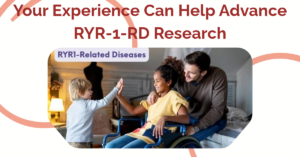
What can researchers learn by following people living with RYR-1-Related Diseases (RYR-1-RD) over time? A lot.
The National Institutes of Health continues to enroll participants in an ongoing Natural History Study of RYR1-Related Disorders. The goal is to better understand how RYR-1-RD affects individuals throughout their lives, including symptoms, challenges, and how these conditions may change over time.
Natural history studies are an important part of rare disease research. By gathering information directly from individuals and families living with RYR-1-RD, researchers can build a clearer picture of the condition and generate knowledge that may help improve clinical care, guide future research, and support the development of clinical trials and potential treatments.
The study is led by Tokunbor A. Lawal, PhD, FNP-BC, an independent investigator within the NIH Division of Intramural Research.
Could You Be Eligible?
You may be eligible to participate if you:
- Are 7 years of age or older
- Have a confirmed genetic diagnosis of RYR-1-RD
- Live in the United States
Individuals with other neuromuscular conditions that also cause muscle weakness are not eligible to participate.
Why Your Participation Matters
For rare diseases like RYR-1-RD, every participant’s experience can add valuable information to the bigger picture.
By participating, you can help researchers better understand RYR-1-RD and provide important data that may shape future research and clinical care. What researchers learn today can help lay the groundwork for tomorrow’s studies and potential treatments.
Interested in Learning More?
To learn more about participating, contact the NIH Office of Patient Recruitment:
📞 (800) 411-1222
📧 ccopr@nih.gov
🔎 Reference Study #001737-CC
Additional study information is available through ClinicalTrials.gov.
Every story adds to what we know. Every participant helps move RYR-1-RD research forward.